Alornyo
- Mailadresse: Karl King Alornyo
- Datum + Kategorie: PhD student

Laboratory for kidney-driven inter-organ signaling
— Sybille Köhler, PhD
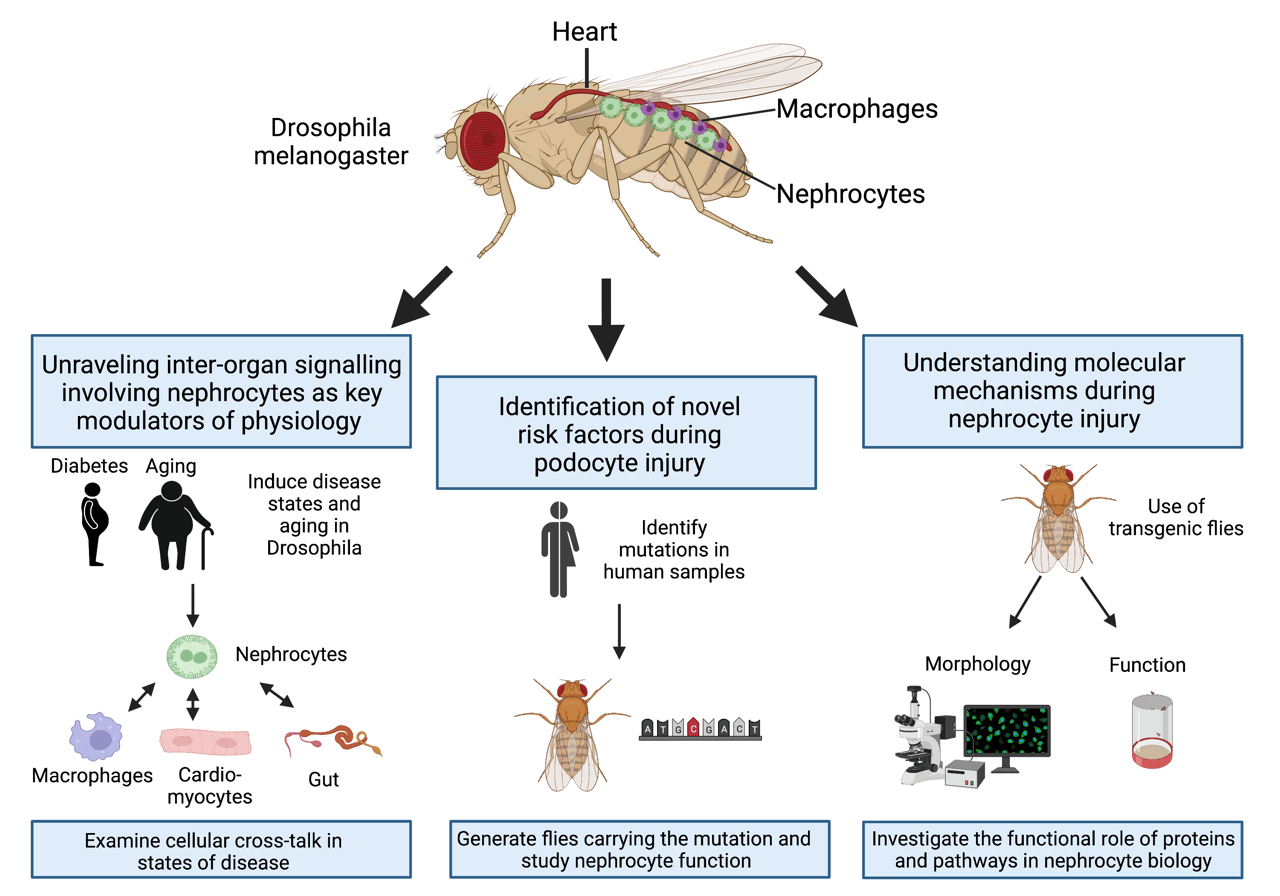
©Sybille Köhler, created with BioRender
The Drosophila(fruit fly) kidney consists of the Malpighian tubules and nephrocytes, the latter representing the homologue cells to mammalian kidney podocytes, as they share a high similarity in morphology and the molecular make-up of the filtration barrier. One major functional role of nephrocytes is to filter and endocytose factors from the haemolymph (blood). This is crucial for fly physiology in states of health and disease, as Drosophila has an open circulatory system. The group of Dr. Sybille Köhler therefore investigates the role of nephrocytes as key modulators of fly physiology in disease states such as diabetes and during aging. In detail, inter-organ signaling including the cross-talk between nephrocytes and the heart, immune system and gut are investigated. In addition, nephrocytes serve as a great tool to study molecular mechanisms such as mechanosensation and protein function. The findings obtained within the fly model will be translated into the mammalian organism to understand mechanisms during podocyte injury in greater detail.
III. Department of Medicine, University Medical Center Hamburg-Eppendorf (UKE)
Martinistr. 52
20246 Hamburg, Germany
| since 2025 | Co-speaker iPRIME-PhD EKFS Medical Scientist Programm |
| since 2025 | Principal Investigator CRC/TRR 422 Project A4 |
| since 2024 | Principal Investigator CRC 1192 Project B3 |
| since 2022 | Principal Investigator STOP-FSGS consortium Project 3 |
| since 2021 | Research Group Leader, III. Department of Medicine (Prof. Tobias Huber), Hamburg, Germany |
|
2008 - 2011
|
Studies in economics, Johannes-Gutenberg-University Mainz, Germany |
| 2005 - 2010 | Studies in biology, Johannes-Gutenberg-University Mainz, Germany |
|
2011 - 2016
|
PhD student, Department II of Internal Medicine, Nephrolab (Prof. T. Benzing), Cologne |
| 2011 | Bachelor thesis, Institute for Management, Johannes-Gutenberg-University Mainz, Germany |
| 2010 | Diploma thesis, Department of Pharmacology, University Hospital Mainz (Dr. S. Horke), Mainz, Germany |
Scientific postgraduate education:
|
2019 - 2021
|
PostDoctoral Fellow, Biomedical Sciences, University of Edinburgh (Dr. Barry Denholm), Scotland, UK |
|
2016 - 2019
|
PostDoc, Department II of Internal Medicine and Center for Molecular Medicine (Prof. P. Brinkkötter), Cologne, Germany |
| 2022 - 2020 | Rahel Liebeschütz-Plaut Mentoring Programme, Mentee |
|
2022 - 2020
|
AJP-Renal Early Career Editorial Fellowship |
|
2019
|
Research fellowship from the Deutsche Forschungsgesellschaft (DFG), Fellow |
|
2017
|
Fritz-Scheler-Stipendium from the German Society of Nephrology |
|
2017
|
NetEX Professorinnenprogramm of the University of Cologne |
| 1. | Elevated Piezo levels cause structural and functional alterations in Drosophila garland nephrocytes. Hazelton-Cavill P, Alornyo KK, Bouchard M, Schulz K, Huber TB, Denholm B, Koehler S. Life Sci Alliance. 2026 Feb 9;9(4):e202503515. |
| 2. | Piezo activity levels need to be tightly regulated to maintain normal morphology and function in pericardial nephrocytes. Schulz K, Hazelton-Cavill P, Alornyo KK, Edenhofer I, Lindenmeyer M, Lohr C, Huber TB, Denholm B, Koehler S. Sci Rep. 2024 Nov 16;14(1):28254. |
| 3. | The 14th International Podocyte Conference 2023: from podocyte biology to glomerular medicine. Koehler S, Hengel FE, Dumoulin B, Damashek L, Holzman LB, Susztak K, Huber TB; International Podocyte Conference Organizing Committee. Kidney Int. 2024 May;105(5):935-952. |
| 4. | The proteasome modulates endocytosis specifically in glomerular cells to promote kidney filtration. Sachs W, Blume L, Loreth D, Schebsdat L, Hatje F, Koehler S, Wedekind U, Sachs M, Zieliniski S, Brand J, Conze C, Florea BI, Heppner F, Krüger E, Rinschen MM, Kretz O, Thünauer R, Meyer-Schwesinger C. T. Nat Commun. 2024 Mar 1;15(1):1897. |
| 5. | A protective role for Drosophila Filamin in nephrocytes via Yorkie mediated hypertrophy.Koehler S, Huber TB, Denholm B. Life Sci Alliance. 2022 Aug 3;5(12):e202101281. |
| 6. | Scaffold polarity proteins Par3A and Par3B share redundant functions while Par3B acts independent of atypical protein kinase C/Par6 in podocytes to maintain the kidney filtration barrier. |
| 7. | Proteome Analysis of Isolated Podocytes Reveals Stress Responses in Glomerular Sclerosis.. |
| 8. | Anaerobic Glycolysis Maintains the Glomerular Filtration Barrier Independent of Mitochondrial Metabolism and Dynamics. |
| 9. | Construction of a viral T2A-peptide based knock-in mouse model for enhanced Cre recombinase activity and fluorescent labeling of podocytes. |
| 10. | A Single and Transient Ca2+ Wave in Podocytes does not induce Changes in Glomerular Filtration and Perfusion. |
| 11. | Par3A is dispensable for the function of the glomerular filtration barrier of the kidney. |

Martinistraße 52
Campus Research II N25
20246 Hamburg Germany