Alornyo
- Mailadresse: Karl King Alornyo
- Datum + Kategorie: PhD student

Laboratory for renal intercellular communication via extracellular vesicles
— Dr. med. Fabian Braun
The Braun lab is always looking for scientists (PhD, PostDoc) and technicians to investigate immune mediated glomerular disease, glomerulosclerosis, Fabry’s disease and acute kidney injury.Please get in touch with your CV via
© Fabian Braun, created with BioRender
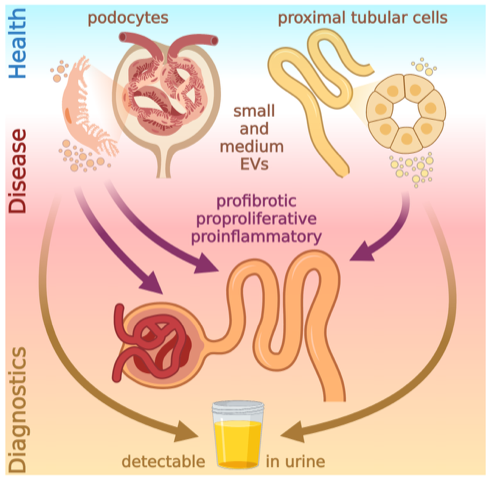
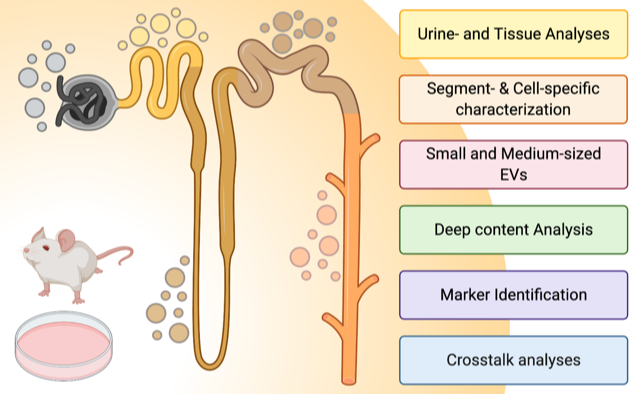
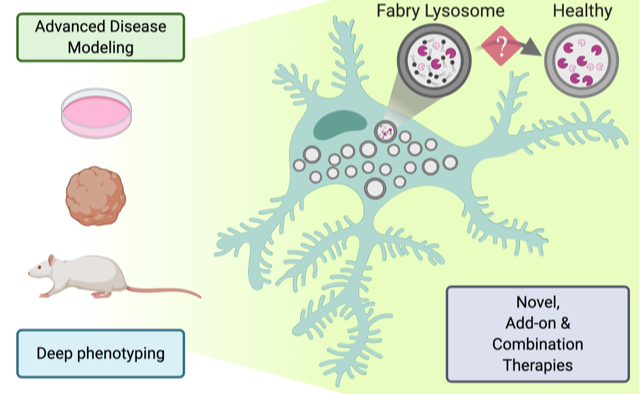
Extracellular vesicles (EVs) have been identified to be critical contributors to cancer cell biology, immune mediation and metabolic signalling. EVs are small membrane bound packages that contain specific proteins, nucleic acids and lipid cargo, facilitating intercellular signalling across great distances. Because of this, the use of EVs as a source for biomarkers has drawn significant attention. Yet, in nephrology, we currently lack 1) a concise understanding of cell-specific vesicle release and content, 2) how renal cells communicate through vesicles and 3) what effect different diseases exert on these parameters. Our group aims to characterize the release and cargo of small and medium-sized extracellular vesicles of podocytes and proximal tubular cells to identify alterations upon cellular damage in glomerular diseases and acute kidney injury. To facilitate this, we employ and establish advanced disease modeling in mice, rats and organoids investigating immune mediated glomerular disease, glomerulosclerosis, Fabry’s disease and acute kidney injury.
Research Group Leader
III. Department of Medicine, University Medical Center Hamburg-Eppendorf (UKE)
Martinistr. 52
20246 Hamburg, Germany
| since 2025 | Principal Investigator CRC/TRR 422 Project B4 |
|
since 2023 |
Managing Attending, III. Department of Medicine, University Medical Center Hamburg- Eppendorf |
|
since 2023 |
Attending Physician at the Martin Zeitz Center for Rare Diseases |
|
since 2022 |
Research Group leader supported by the iSTAR program for advanced clinician scientists |
|
since 2018 |
Physician, III. Department of Medicine, University Medical Center Hamburg- Eppendorf, Prof. Dr. Tobias B. Huber |
|
2006 - 2012
|
Study of Medicine, University of Cologne, Germany |
|
2024 |
Board Certification in Nephrology and Internal Medicine |
|
2022 |
Board Certification in Internal Medicine |
|
2013 - 2017- 2020
|
Clinician Scientist at the Department II of Internal Medicine and Center for Molecular Medicine Cologne, University of Cologne, Germany |
|
2011 - 2014
|
MD Thesis: „The molecular pathogenesis of Fabry disease in human podocytes“ at the Department II of Internal Medicine and Center for Molecular Medicine Cologne, University of Cologne, Germany, supported for one year by the „Köln Fortune“ scholarship program |
Clinical postgraduate education:
|
since 2018
|
Physician, III. Department of Medicine, University Medical Center Hamburg- Eppendorf, Prof. Dr. Tobias B. Huber |
|
2013 - 2017
|
Physician, Department II of Internal Medicine and Center for Molecular Medicine Cologne, University of Cologne, Germany |
Scientific postgraduate education:
|
starting 2023
|
iSTAR Program for Advanced Clinician Scientists |
|
since 2021
|
Clinician Scientist through an Else-Kröner Memorial-Scholarship |
|
2019 - 2020
|
Gerok Position at the CRC 1192: Immune-Mediated Glomerular Diseases |
|
2022 - 2020
|
Teacher of the Year 2022 – for Module E awarded by the Students and faculty of the University Medical Center Hamburg-Eppendorf |
|
2021
|
Research Scholarship 2021 of the German Society of Nephrology, Berlin, Germany |
|
2020
|
Paper of the Month, August 2020, Braun et al., SARS-CoV-2 renal tropism associates with acute kidney injury, The Lancet |
| 1. |
Braun F, Mandel AM, Blomberg L, Wong MN, Chatzinikolaou G, Meyer DH, Reinelt A, Nair V, Akbar-Haase R, McCown PJ, Haas F, Chen H, Rahmatollahi M, Fermin D, Ebbestad R, Slaats GG, Bork T, Schell C, Koehler S, Brinkkoetter PT, Lindenmeyer MT, Cohen CD, Kann M, Unnersjö-Jess D, Bloch W, Sampson MG, Dollé ME, Puelles VG, Kretzler M, Garinis GA, Huber TB, Schermer B, Benzing T, Schumacher B, Kurschat CE. JCI Insight. 2025 May 20:e172370. |
| 2. |
Ng MSY, Burger D, Svenningsen P, Martens E, Erdbrügger U, Braun F. Kidney Int. 2025 Jan;107(1):44-50. |
| 3. |
Lassé M, El Saghir J, Berthier CC, Eddy S, Fischer M, Laufer SD, Kylies D, Hutzfeldt A, Bonin LL, Dumoulin B, Menon R, Vega-Warner V, Eichinger F, Alakwaa F, Fermin D, Billing AM, Minakawa A, McCown PJ, Rose MP, Godfrey B, Meister E, Wiech T, Noriega M, Chrysopoulou M, Brandts P, Ju W, Reinhard L, Hoxha E, Grahammer F, Lindenmeyer MT, Huber TB, Schlüter H, Thiel S, Mariani LH, Puelles VG, Braun F, Kretzler M, Demir F, Harder JL, Rinschen MM. Nat Commun. 2023 Aug 14;14(1):4903. |
| 4. |
Braun F, Abed A, Sellung D, Rogg M, Woidy M, Eikrem O, Wanner N, Gambardella J, Laufer SD, Haas F, Wong MN, Dumoulin B, Rischke P, Mühlig AK, Sachs W, von Cossel K, Schulz K, Muschol N, Gersting SW, Muntau AC, Kretz O, Hahn O, Rinschen MM, Mauer M, Bork T, Grahammer F, Liang W, Eierhoff T, Römer W, Hansen A, Meyer-Schwesinger C, Iaccarino G, Tøndel C, Marti HP, Najafian B, Puelles VG, Schell C, Huber TB. J Clin Invest. 2023 Apr 4:e157782. |
| 5. | SARS-CoV-2 renal tropism associates with acute kidney injury. |
| 6. | Multiorgan and Renal Tropism of SARS-CoV-2. |
| 7. |
Braun F, Rinschen M, Buchner D, Bohl K, Plagmann I, Bachurski D, Richard Späth M, Antczak P, Göbel H, Klein C, Lackmann JW, Kretz O, Puelles VG, Wahba R, Hallek M, Schermer B, Benzing T, Huber TB, Beyer A, Stippel D, Kurschat CE, Müller RU. J Extracell Vesicles. 2020 Oct;10(1):e12026. |
| 8. | Enzyme Replacement Therapy Clears Gb3 Deposits from a Podocyte Cell Culture Model of Fabry Disease but Fails to Restore Altered Cellular Signaling. |
| 9. |
Slaats GG, Braun F, Hoehne M, Frech LE, Blomberg L, Benzing T, Schermer B, Rinschen MM, Kurschat CE. Sci Rep. 2018 Jul 23;8(1):11042. |
| 10. |
Braun F, Rinschen MM, Bartels V, Frommolt P, Habermann B, Hoeijmakers JH, Schumacher B, Dollé ME, Müller RU, Benzing T, Schermer B, Kurschat CE. Aging (Albany NY). 2016 Mar;8(3):441-57. |
Team
— Tilo Freiwald, MD
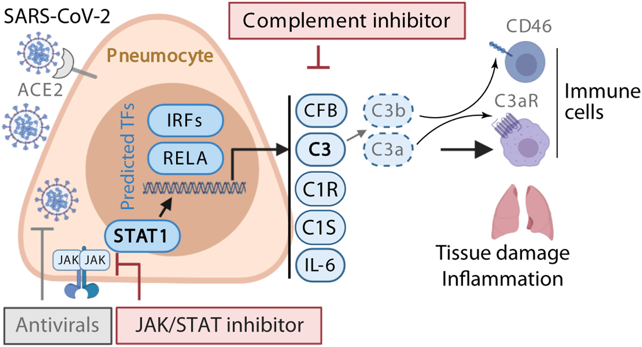
Tissue inflammation is a key determinant of kidney fibrosis and progressive loss of organ function. Defective control and deregulation of the complement pathways is a hallmark of a broad range of kidney diseases leading to fibrosis, including C3 glomerulopathy, haemolytic uraemic syndrome (HUS), lupus nephritis, and ANCA-associated necrotising glomerulonephritis. These are all diseases in which complement targeting therapies are being developed.
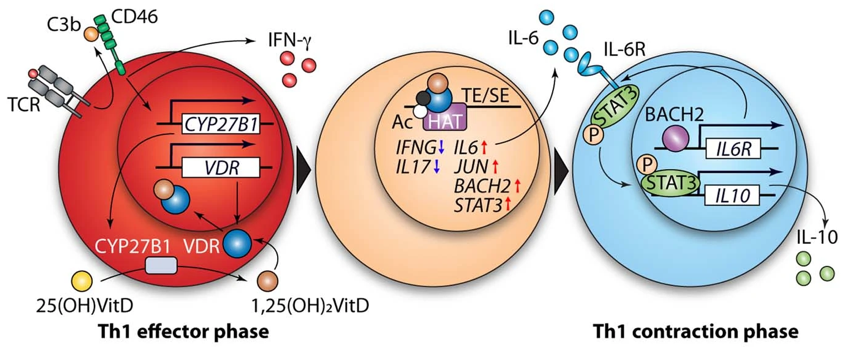
Complement proteins are present both within the circulation and made locally by kidney cells because these are sites inaccessible to plasma-circulating complement. Currently approved pharmaceuticals only target the complement that is present within the circulation. We believe that elucidating the local and intracellular, as opposed to systemic, complement functions will lead to a better understanding of the specific causes and consequences of complement activation in related diseases. We and others have shown that these non-canonical functions of complement fundamentally shape immune and non-immune cell function and metabolism. Improved knowledge of the role of the complement system in kidney-specific inflammation will provide a rationale to further target and personalise anti-inflammatory kidney therapeutics as well as inform the need for intracellular and local drug delivery.
Our lab routinely employs state of the art multi-dimensional single cell genomic methodologies and has computational expertise that allows us to handle big data challenges by bringing machine learning and AI to bench and bedside. Through our international partnerships we share the latest innovations and bring exchange opportunities at other top institutions to our trainees. Our role as co-founder of the medical knowledge platform AMBOSS highlights our commitment to mentorship and training in the medical field.
The Freiwald lab is committed to promotion of practices that support diversity and inclusion in clinicalscience.
The Freiwald lab is always looking for scientists (PhD, PostDoc) and technicians to unravel mechanisms and translate the role of the innate immunity′s complement system in inflammatory kidney disease.Please get in touch with your CV via
Research Group Leader
III. Department of Medicine, University Medical Center Hamburg-Eppendorf (UKE)
Martinistr. 52
20246 Hamburg, Germany
| since 2022 | Junior group leader supported by the BMBF iSTAR Advanced Clinician Scientist program |
| since 2022 | Physician, III. Department of Medicine, University Medical Center Hamburg-Eppendorf, Prof. Dr. T. B. Huber |
|
2004 - 2011
|
Study of Medicine, University Hamburg, Germany. Clinical rotations at King’s College London, Cerrahpasa Medical Faculty Istanbul University and Stadtspital Waid Zurich
|
|
2020 - 2022- 2020
|
DFG Fellowship at Immunoregulation Section and Laboratory for Complement and Inflammation Research, National Institutes of Health, Bethesda, Maryland, USA (Dr. B. Afzali/NIDDK and Dr. C. Kemper/NHLBI) |
|
2018 - 2020
|
Postdoctoral Fellowship at Immunoregulation Section and Laboratory for Complement and Inflammation Research, National Institutes of Health, Bethesda, Maryland, USA (Dr. B. Afzali/NIDDK and Dr. C. Kemper/NHLBI) |
|
2009 - 2014
|
MD thesis, Institute of Immunology, University Medical Center Hamburg-Eppendorf, Prof. Dr. F. Haag |
Clinical postgraduate education:
| 2018 | Nephrology fellow at the III. Department of Medicine, University Hospital Frankurt, Germany |
| 2018 | Board Certification for Internal Medicine |
|
2017
|
Board Certification for Emergency Medicine |
|
2013 - 2018
|
Physician, III. Department of Medicine, University Hospital Frankurt, Germany |
Scientific postgraduate education:
|
2020 - 2022
|
DFG Fellowship at Immunoregulation Section and Laboratory for Complement and Inflammation Research, National Institutes of Health, Bethesda, Maryland, USA (Dr. B. Afzali/NIDDK and Dr. C. Kemper/NHLBI) |
|
2018 - 2020
|
Postdoctoral Fellowship at Immunoregulation Section and Laboratory for Complement and Inflammation Research, National Institutes of Health, Bethesda, Maryland, USA (Dr. B. Afzali/NIDDK and Dr. C. Kemper/NHLBI) |
|
2012 - 2013
|
Co-founder and Chief Technology Officer of AMBOSS GmbH |
|
since 2022 - 2020
|
Spokesperson BMBF iSTAR Clinician Scientists Hamburg |
|
2022
|
Orloff Science Award from the NIH for work on complement biology |
| 1. | The secret life of complement: challenges and opportunities in exploring functions of the complosome in disease. |
| 2. | C5a-licensed phagocytes drive sterilizing immunity during systemic fungal infection. |
| 3. | Systematic single-cell pathway analysis to characterize early T cell activation. |
| 4. | Autocrine vitamin D signaling switches off pro-inflammatory programs of TH1 cells. |
| 5. | Mitochondrial C5aR1 activity in macrophages controls IL-1β production underlying sterile inflammation.Mitochondrial C5aR1 activity in macrophages controls IL-1β production underlying sterile inflammation.Mitochondrial C5aR1 activity in macrophages controls IL-1β production underlying sterile inflammation. |
| 6. | SARS-CoV-2 drives JAK1/2-dependent local complement hyperactivation.SARS-CoV-2 drives JAK1/2-dependent local complement hyperactivation. |
| 7. | Renal diseases and the role of complement: Linking complement to immune effector pathways and therapeutics. |
| 8. | CD4+ T cell lymphopenia predicts mortality from Pneumocystis pneumonia in kidney transplant patients. |
| 9. | Aberrant type 1 immunity drives susceptibility to mucosal fungal infections. |
| 10. | Diapedesis-Induced Integrin Signaling via LFA-1 Facilitates Tissue Immunity by Inducing Intrinsic Complement C3 Expression in Immune Cells. |
| 11. | Pattern recognition as a concept for multiple-choice questions in a national licensing exam. |
* Represents equal contributions as co-first or co-senior authors. |

Martinistraße 52
Campus Research II N25
20246 Hamburg Germany