Huang
- Mailadresse: Ming Huang, PhD
- Datum + Kategorie: Post Doc

Laboratory for kidney-driven inter-organ signaling
— Sybille Köhler, PhD
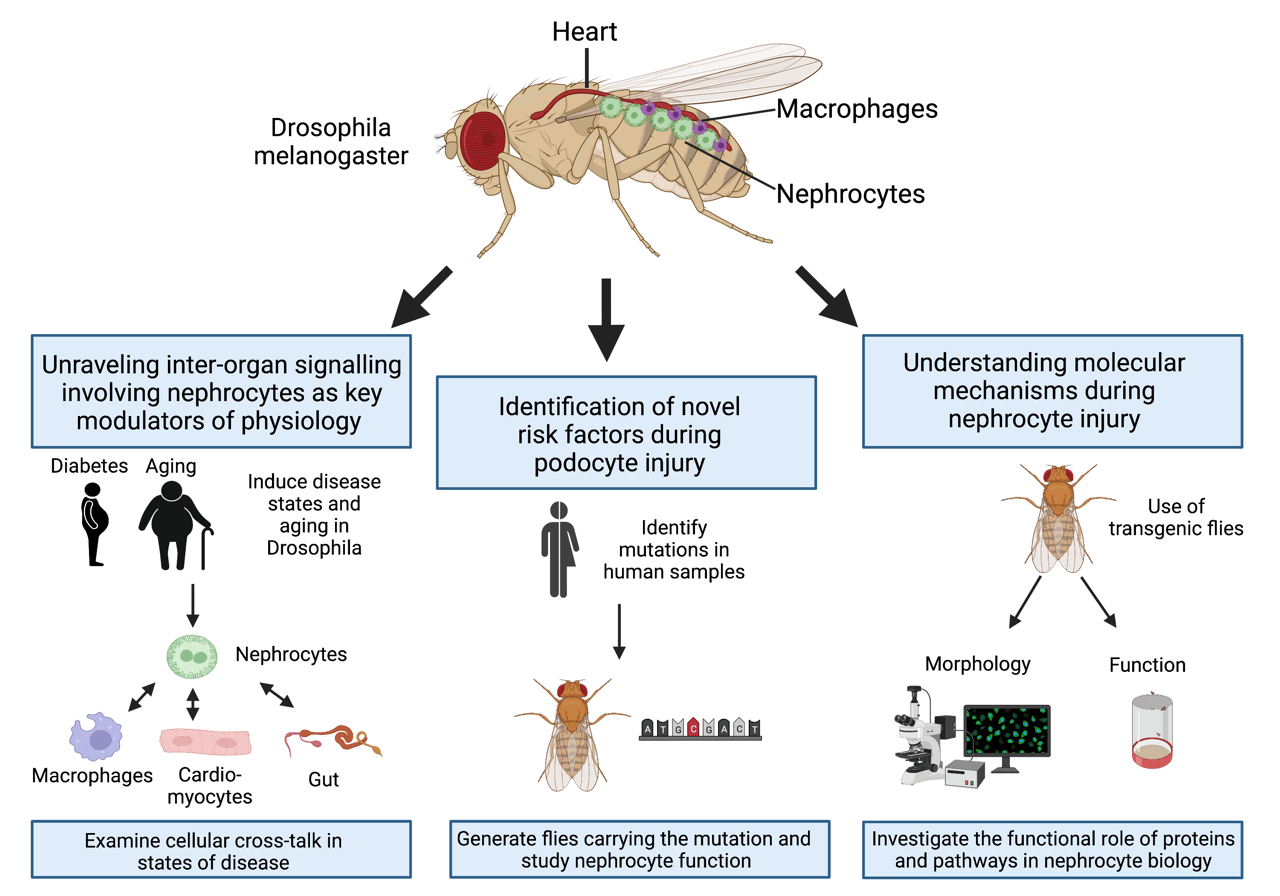
©Sybille Köhler, created with BioRender
The Drosophila(fruit fly) kidney consists of the Malpighian tubules and nephrocytes, the latter representing the homologue cells to mammalian kidney podocytes, as they share a high similarity in morphology and the molecular make-up of the filtration barrier. One major functional role of nephrocytes is to filter and endocytose factors from the haemolymph (blood). This is crucial for fly physiology in states of health and disease, as Drosophila has an open circulatory system. The group of Dr. Sybille Köhler therefore investigates the role of nephrocytes as key modulators of fly physiology in disease states such as diabetes and during aging. In detail, inter-organ signaling including the cross-talk between nephrocytes and the heart, immune system and gut are investigated. In addition, nephrocytes serve as a great tool to study molecular mechanisms such as mechanosensation and protein function. The findings obtained within the fly model will be translated into the mammalian organism to understand mechanisms during podocyte injury in greater detail.
III. Department of Medicine, University Medical Center Hamburg-Eppendorf (UKE)
Martinistr. 52
20246 Hamburg, Germany
| since 2025 | Co-speaker iPRIME-PhD EKFS Medical Scientist Programm |
| since 2025 | Principal Investigator CRC/TRR 422 Project A4 |
| since 2024 | Principal Investigator CRC 1192 Project B3 |
| since 2022 | Principal Investigator STOP-FSGS consortium Project 3 |
| since 2021 | Research Group Leader, III. Department of Medicine (Prof. Tobias Huber), Hamburg, Germany |
|
2008 - 2011
|
Studies in economics, Johannes-Gutenberg-University Mainz, Germany |
| 2005 - 2010 | Studies in biology, Johannes-Gutenberg-University Mainz, Germany |
|
2011 - 2016
|
PhD student, Department II of Internal Medicine, Nephrolab (Prof. T. Benzing), Cologne |
| 2011 | Bachelor thesis, Institute for Management, Johannes-Gutenberg-University Mainz, Germany |
| 2010 | Diploma thesis, Department of Pharmacology, University Hospital Mainz (Dr. S. Horke), Mainz, Germany |
Scientific postgraduate education:
|
2019 - 2021
|
PostDoctoral Fellow, Biomedical Sciences, University of Edinburgh (Dr. Barry Denholm), Scotland, UK |
|
2016 - 2019
|
PostDoc, Department II of Internal Medicine and Center for Molecular Medicine (Prof. P. Brinkkötter), Cologne, Germany |
| 2022 - 2020 | Rahel Liebeschütz-Plaut Mentoring Programme, Mentee |
|
2022 - 2020
|
AJP-Renal Early Career Editorial Fellowship |
|
2019
|
Research fellowship from the Deutsche Forschungsgesellschaft (DFG), Fellow |
|
2017
|
Fritz-Scheler-Stipendium from the German Society of Nephrology |
|
2017
|
NetEX Professorinnenprogramm of the University of Cologne |
| 1. | Elevated Piezo levels cause structural and functional alterations in Drosophila garland nephrocytes. Hazelton-Cavill P, Alornyo KK, Bouchard M, Schulz K, Huber TB, Denholm B, Koehler S. Life Sci Alliance. 2026 Feb 9;9(4):e202503515. |
| 2. | Piezo activity levels need to be tightly regulated to maintain normal morphology and function in pericardial nephrocytes. Schulz K, Hazelton-Cavill P, Alornyo KK, Edenhofer I, Lindenmeyer M, Lohr C, Huber TB, Denholm B, Koehler S. Sci Rep. 2024 Nov 16;14(1):28254. |
| 3. | The 14th International Podocyte Conference 2023: from podocyte biology to glomerular medicine. Koehler S, Hengel FE, Dumoulin B, Damashek L, Holzman LB, Susztak K, Huber TB; International Podocyte Conference Organizing Committee. Kidney Int. 2024 May;105(5):935-952. |
| 4. | The proteasome modulates endocytosis specifically in glomerular cells to promote kidney filtration. Sachs W, Blume L, Loreth D, Schebsdat L, Hatje F, Koehler S, Wedekind U, Sachs M, Zieliniski S, Brand J, Conze C, Florea BI, Heppner F, Krüger E, Rinschen MM, Kretz O, Thünauer R, Meyer-Schwesinger C. T. Nat Commun. 2024 Mar 1;15(1):1897. |
| 5. | A protective role for Drosophila Filamin in nephrocytes via Yorkie mediated hypertrophy.Koehler S, Huber TB, Denholm B. Life Sci Alliance. 2022 Aug 3;5(12):e202101281. |
| 6. | Scaffold polarity proteins Par3A and Par3B share redundant functions while Par3B acts independent of atypical protein kinase C/Par6 in podocytes to maintain the kidney filtration barrier. |
| 7. | Proteome Analysis of Isolated Podocytes Reveals Stress Responses in Glomerular Sclerosis.. |
| 8. | Anaerobic Glycolysis Maintains the Glomerular Filtration Barrier Independent of Mitochondrial Metabolism and Dynamics. |
| 9. | Construction of a viral T2A-peptide based knock-in mouse model for enhanced Cre recombinase activity and fluorescent labeling of podocytes. |
| 10. | A Single and Transient Ca2+ Wave in Podocytes does not induce Changes in Glomerular Filtration and Perfusion. |
| 11. | Par3A is dispensable for the function of the glomerular filtration barrier of the kidney. |
Laboratory for structural biology of the kidney
— Oliver Kretz, MD
Many of the phenotypes in human kidney disease are only detectable at the ultrastructural level. This holds also true for the model systems of genetic and epigenetic based disturbances of renal development, biology or aging. Our group applies transmission and scanning microscope techniques in human and animal tissue (e.g. mouse, rat, zebrafish, drosophila) in order to detect and characterize subtle ultrastructural alterations e.g. of the glomerular filtration barrier, the actin cytoskeleton or intracellular vesicle formation and trafficking at a qualitative and quantitative level.
Moreover, our thematic focus deals with the understanding of mechanisms underlying kidney aging which is an issue of growing relevance in the aging population of western countries. To this end we make use of the progeroid Ercc1Δ/- mutant mouse line as an experimental platform for studies into aging. It harbors attenuated Excision repair cross-complementation 1 activity, a key component of several DNA repair pathways. In this model system we apply different conditions which we and others have recently shown to have beneficial effects on aging like modulation of the activin/myostatin pathway or dietary restriction. By deep morphological, functional and molecular (single nuclei transcriptomics) analysis we aim to identify pathways involved in aging in different cell types of the kidney and in other organs like muscle, liver or CNS. Finally, we have a special interest in the concept of inter-organ communication during aging that is now emerging. We hope to identify kidney derived factors influencing the aging of other organ systems and vice versa.
III. Department of Medicine, University Medical Center Hamburg-Eppendorf (UKE)
Martinistr. 52
20246 Hamburg, Germany
| since 2025 |
Co-Director Core Facility for Electron Microscopy, UKE & Center for Molecular Neurobiology Hamburg |
|
since 2017 |
Laboratory head, Electron microscopy facility, III. Department of Medicine, University Medical Center Hamburg-Eppendorf, Prof. Dr. Tobias B. Huber |
|
1987 - 1994 |
Study of Medicine, University Saarbrücken, Germany; University Rennes (F); University Vienna (A) and University Kiel, Germany (final exam: sehr gut) |
|
2006 - 2010 |
Master of Health Business Administration, University Erlangen-Nürnberg, Germany |
|
2006 |
Habilitation in “Anatomy and cell biology” at the University of Freiburg (“Steroid hormone signaling in the CNS”) |
|
1998 |
MD at the University of Saarbrücken („Regulation of the hypothalamo-pituitary-adrenal axis in glucocorticoid receptor knockout mice “ - magna cum laude) |
|
Scientific postgraduate education: |
|
|
2014 - 2017 |
Laboratory head, Electron microscopy facility, IV. Medical Clinic, University Medical Center Freiburg, Prof. Dr. Tobias B. Huber |
|
2013 - 2014 |
Senior Scientist, BIOSS Cluster of Excellence, University Freiburg, Germany |
|
2009 - 2013 |
Group leader and Senior scientist at the Division of Neuroanatomy (Chair: Prof. Dr. M. Frotscher) |
|
2001 - 2007 |
Postdoctoral fellow, Department of Anatomy and cell biology, University Freiburg (Prof. Dr. M. Frotscher) |
|
1999 - 2001 |
Postdoctoral fellow, Division Molecular Biology of the Cell I, German Cancer Research Center, Heidelberg (Chair. Prof. Dr. G. Schütz) |
|
1995 - 1998 |
Postdoctoral fellow, Department of Anatomy, Neuroanatomical Division, University Saarbrücken |
|
2001 |
EMBO short term fellow |
|
1999 - 2001 |
DFG research fellow |
|
1999 |
Young Investigator Award of the University Saarbrücken |
| 1. |
Rogg M, Weißer L, Maier JI, Sigle A, Helmstädter M, Stigler M, Sammarco A, Gräwe K, Andreev G, Kark C, Ramakrishnan SK, Özel C, Butt L, Arnold F, Bechtel-Walz W, Schilling O, Tanriver Y, Brinkkötter P, Grabbert M, Simons M, Werner M, Kretz O, Benzing T, Huber TB, Schell C. Sci Adv. 2025 Nov 28;11(48):eady1623. |
| 2. |
Zahner G, Dehde S, Seifert L, Huang M, Kretz O, Huber TB, Tomas NM. Kidney Int. 2025 Dec;108(6):1179-1183. |
| 3. |
Czogalla J, Hausmann F, Lagies S, Gies SE, Christiansen S, Kaiser N, Haas F, Okabayashi Y, Kylies D, Hofmann S, Franzin R, Sabra N, Bouari S, Fang Y, Ambagtsheer G, Edenhofer I, Chilla S, Mühlig AK, Zimmermann M, Wong MN, Yokoo T, Kretz O, Lindenmeyer M, Grahammer F, Hoogduijn MJ, de Bruin R, Kuehl M, Hänzelmann S, Kammerer B, Gesualdo L, Bonn S, Minnee RC, Huber TB, Puelles VG. JCI Insight. 2025 Sep 23;10(18):e190185. |
| 4. |
Kuehl M, Okabayashi Y, Wong MN, Gernhold L, Gut G, Kaiser N, Schwerk M, Gräfe SK, Ma FY, Tanevski J, Schäfer PSL, Mezher S, Sarabia Del Castillo J, Goldbeck-Strieder T, Zolotareva O, Hartung M, Delgado Chaves FM, Klinkert L, Gnirck AC, Spehr M, Fleck D, Joodaki M, Parra V, Shaigan M, Diebold M, Prinz M, Kranz J, Kux JM, Braun F, Kretz O, Wu H, Grahammer F, Heins S, Zimmermann M, Haas F, Kylies D, Wanner N, Czogalla J, Dumoulin B, Zolotarev N, Lindenmeyer M, Karlson P, Nyengaard JR, Sebode M, Weidemann S, Wiech T, Groene HJ, Tomas NM, Meyer-Schwesinger C, Kuppe C, Kramann R, Karras A, Bruneval P, Tharaux PL, Pastene D, Yard B, Schaub JA, McCown PJ, Pyle L, Choi YJ, Yokoo T, Baumbach J, Sáez PJ, Costa I, Turner JE, Hodgin JB, Saez-Rodriguez J, Huber TB, Bjornstad P, Kretzler M, Lenoir O, Nikolic-Paterson DJ, Pelkmans L, Bonn S, Puelles VG. Nature. 2025 Jul 18. doi: 10.1038/s41586-025-09225-2. |
| 5. |
Hengel FE, Dehde S, Kretz O, Engesser J, Zimmermann T, Huber TB, Tomas NM. J Clin Invest. 2025 Jan 16;135(5):e186769. |
| 6. |
Vermeij WP, Alyodawi K, van Galen I, von der Heide JL, Birkisdóttir MB, Van't Sant LJ, Ozinga RA, Komninos DSJ, Smit K, Rijksen YMA, Brandt RMC, Barnhoorn S, Jaarsma D, Vaiyapuri S, Ritvos O, Huber TB, Kretz O, Patel K. J Cachexia Sarcopenia Muscle. 2024 Dec;15(6):2361-2374. |
| 7. |
Hengel FE, Dehde S, Lassé M, Zahner G, Seifert L, Schnarre A, Kretz O, Demir F, Pinnschmidt HO, Grahammer F, Lucas R, Mehner LM, Zimmermann T, Billing AM, Oh J, Mitrotti A, Pontrelli P, Debiec H, Dossier C, Colucci M, Emma F, Smoyer WE, Weins A, Schaefer F, Alachkar N, Diemert A, Hogan J, Hoxha E, Wiech T, Rinschen MM, Ronco P, Vivarelli M, Gesualdo L, Tomas NM, Huber TB; International Society of Glomerular Disease. N Engl J Med. 2024 Aug 1;391(5):422-433. |
| 8. |
Tresse E, Marturia-Navarro J, Sew WQG, Cisquella-Serra M, Jaberi E, Riera-Ponsati L, Fauerby N, Hu E, Kretz O, Aznar S, Issazadeh-Navikas S. Mol Psychiatry. 2023 Nov;28(11):4902-4914. |
| 9. |
Nat Nanotechnol. 2023 Apr;18(4):336-342. |
| 10. |
Schaupp L, Muth S, Rogell L, Kofoed-Branzk M, Melchior F, Lienenklaus S, Ganal-Vonarburg SC, Klein M, Guendel F, Hain T, Schütze K, Grundmann U, Schmitt V, Dorsch M, Spanier J, Larsen PK, Schwanz T, Jäckel S, Reinhardt C, Bopp T, Danckwardt S, Mahnke K, Heinz GA, Mashreghi MF, Durek P, Kalinke U, Kretz O, Huber TB, Weiss S, Wilhelm C, Macpherson AJ, Schild H, Diefenbach A, Probst HC. Cell. 2020 May 28;181(5):1080-1096.e19. |
| 11. |
Klein Geltink RI, O'Sullivan D, Corrado M, Bremser A, Buck MD, Buescher JM, Firat E, Zhu X, Niedermann G, Caputa G, Kelly B, Warthorst U, Rensing-Ehl A, Kyle RL, Vandersarren L, Curtis JD, Patterson AE, Lawless S, Grzes K, Qiu J, Sanin DE, Kretz O, Huber TB, Janssens S, Lambrecht BN, Rambold AS, Pearce EJ, Pearce EL. Cell.2017 Oct 5;171(2):385-397.e11. |
| 12. |
Chatterjee A, Seyfferth J, Lucci J, Gilsbach R, Preissl S, Böttinger L, Mårtensson CU, Panhale A, Stehle T, Kretz O, Sahyoun AH, Avilov S, Eimer S, Hein L, Pfanner N, Becker T, Akhtar A. Cell.2016 Oct 20;167(3):722-738.e23. |
| 13. |
Buck MD, O'Sullivan D, Klein Geltink RI, Curtis JD, Chang CH, Sanin DE, Qiu J, Kretz O, Braas D, van der Windt GJ, Chen Q, Huang SC, O'Neill CM, Edelson BT, Pearce EJ, Sesaki H, Huber TB, Rambold AS, Pearce EL. Cell. 2016 Jun 30;166(1):63-76. |
Biobanking Study group
— Maja Lindenmeyer, PhD
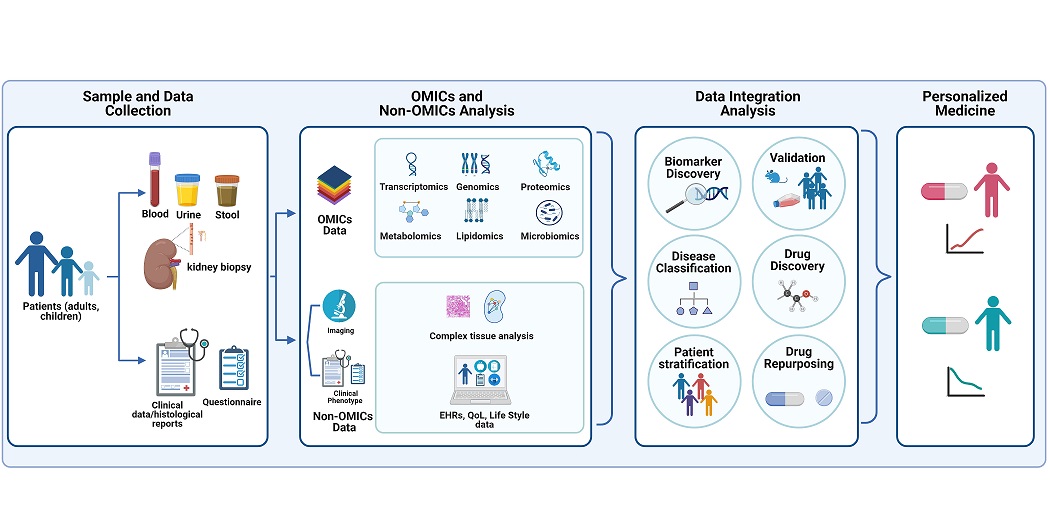
©Maja Lindenmeyer, created with BioRender
Our group represents the core facility of the “European Renal cDNA Bank-Kroener Fresenius Biopsy Bank” (ERCB-KFB), a multicenter study for gene expression analysis in different human renal diseases, and the “Hamburg and European Renal Omics Bank” (HERO), a collaborative project for conducting translational research in human renal diseases. Using state of the art omics and non-omics technologies, we aim to
III. Department of Medicine, University Medical Center Hamburg-Eppendorf (UKE)
Martinistr. 52
20246 Hamburg, Germany
| since 2025 | Principal Investigator CRC/TRR 422 Project CP3 |
| since 2024 | Principal Investigator CRC 1192 |
| since 2022 | Principal Investigator / Co-Coordinator BMBF STOP-FSGS |
|
since 2022
|
Principal Investigator BMBF UPTAKE |
|
since 2021
|
Project Leader/ Study Coordinator of the Hamburg and European Renal Omics Biobank (HERO) |
|
since 2018
|
Laboratory head, III. Department of Medicine, UKE, Prof. Dr. T. B. Huber |
| since 2018 | Coordinator of the ERCB |
|
1994 – 2000
|
Chemistry, Technical University Karlsruhe, University of Freiburg |
|
2014 - 2020
|
Habilitation in Molecular Nephrology, University of Zurich (Switzerland) |
|
2004
|
PhD, Department of Pharmaceutical Biology and Biotechnology, University of Freiburg |
|
2000
|
Diploma in Chemistry, University of Freiburg |
|
2015 – 2018
|
Junior Group leader, Nephrology Center, IV. Department of Medicine, University Hospital of Munich (LMU) |
|
2012 – 2018
|
Deputy-Coordinator of the European Renal cDNA Bank-Kroener Fresenius |
|
2010 – 2014
|
Laboratory Head of the Nephrology Lab Zurich, University of Zurich (Switzerland) |
|
2008 – 2010
|
Postdoctoral Fellow, Institute of Physiology and Division of Nephrology, University of Zurich (Switzerland), Prof. Dr. C. Cohen |
|
2006 – 2007
|
Postdoctoral Fellow, Nephrology Center, IV. Deparment of Medicine, University Hospital of Munich (LMU), Prof Dr. C. Cohen |
|
2004 – 2005
|
Postdoctoral Fellow, School of Biological Sciences, Queen Mary College, London (UK), Prof. Dr. M. Warren |
|
2010 - 2020
|
Habilitation Scholarship of the Holcim Foundation |
|
2004 – 2005
|
Post-Doc fellowship of the German Academic Exchange Service (DAAD) |
|
2001 – 2003
|
PhD fellowship of the “Landesgraduiertenförderung Baden-Württemberg” |
| 1. | Molecular consequences of SARS-CoV-2 liver tropism. |
| 2. | Pro-cachectic factors link experimental and human chronic kidney disease to skeletal muscle wasting. |
| 3. | Endothelial-Specific Deletion of CD146 Protects Against Experimental Glomerulonephritis in Mice. |
| 4. | SARS-CoV-2 renal tropism associates with acute kidney injury. |
| 5. | ADAM10-Mediated Ectodomain Shedding Is an Essential Driver of Podocyte Damage. |
| 6. | Dysregulated mesenchymal PDGFR-β drives kidney fibrosis |
| 7. | Multiorgan and Renal Tropism of SARS-CoV-2. |
| 8. | Tubular NOX4 expression decreases in chronic kidney disease but does not modify fibrosis evolution. |
| 9. | Metabolic pathways and immunometabolism in rare kidney diseases. |
| 10. | Transcriptome-based network analysis reveals renal cell type-specific dysregulation of hypoxia-associated transcripts. *contributed equally |

Martinistraße 52
Campus Research II N25
20246 Hamburg Germany